Arkie shirt

Last week I had a camp collar shirt curiosity that morphed into a frequency illusion. This type of shirt has been around for ages, but it has become quite trendy. While I was making this my husband commented that he saw an “article” about the sudden popularity of the Kramer shirt.

After this shirt style was on my mind for a couple of days, I started looking for a pattern to use to make my own. I found out this type of collar goes by many names: revere collar, cuban collar, camp collar among others. My go-to of “camp collar” is not the most universal, so I had trouble finding patterns. I finally thought to check Tessuti. Not sure if it was my subconsious or what but they released the Arkie Shirt this year, and it fit my vision perfectly!

Fabric and buttons

I wanted to use stashed fabric only for this first version. I had just less than enough of some white Merchant and Mills linen, so I had to get creative with how to use it most efficiently. I couldn’t figure out a cutting layout to accommodate the front facing pieces, so I mulled over my other options. I finally decided on some pink cotton for the facing and a brick red cotton for the collar. I thought that the patchwork of colors plus a Liberty fabric pocket would look quirky and cute, but I quickly became concerned that this was giving bowling shirt vibes. I ripped out the red collar piece, and pieced together a new under collar in the white linen instead.

“you’re a disaster my guy” (before I ripped out the red collar)

The buttons are a gift from my friend Alexis, she found them at a flea market. I thought the stripes were pink because I was sewing in very low light 😭, but after I fell in love with them I realized they are orange! I think they look perfect.

Sizing and construction

I went down a size from what the pattern recommended; I cut a straight size 8. The ease is quite generous, and because this is a new silhouette for me, I wanted it to be a bit more close-fitting.

Instead of the recommended seam finishes, I used french seams throughout. I admit that french seams look a bit bulky at the shoulders, but this linen is an unravel-y mess and needs the frenchies. I used this fab tutorial for finishing the side seam splits and they look great.

This was the first time I used the crimp stitch. I did some googling to make sure I was doing it correctly, and I found this great tutorial from a delightful sewer. I think I’ll be using the crimp stitch instead of doing a gathering stitch to prep my set-in sleeve heads from now on.

I sewed down the facing because I hate the feeling of a flapping, floppy facing. This becomes especially annoying when the garment comes out of the wash. I topstitched the shoulder and arm seams. Lastly, I hand-sewed the facing at the shoulder as well as the collar to make sure it looked perfect.

Conclusion

I loved trying out a new type of collar construction (no collar stand!) on this garment. Sewing this collar was pretty easy.

I saw some complaints that the directions in this pattern was hard to follow. I found a few bits tricky, but I read carefully and was able to figure out each step without problems. I love it!

Olya Dress

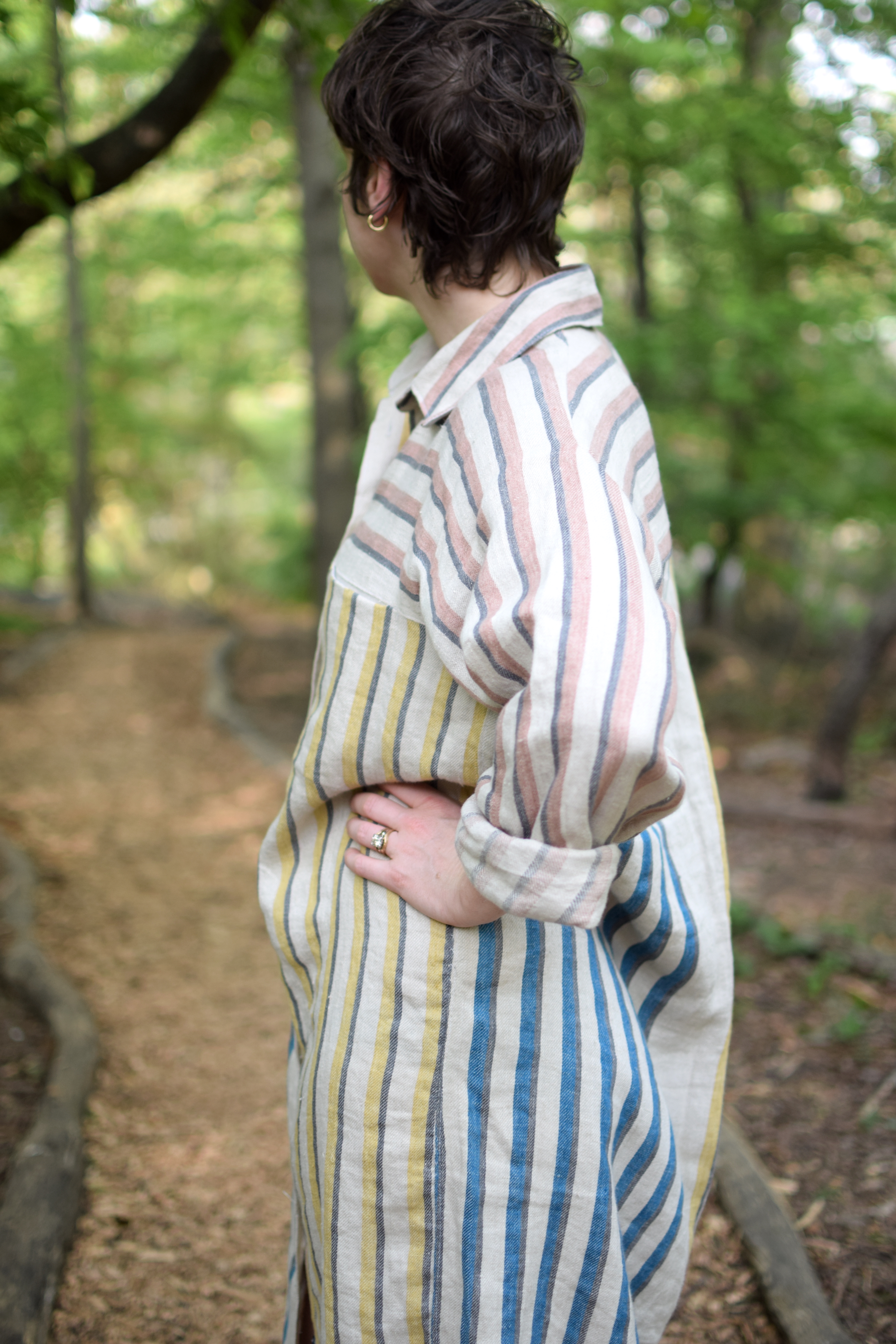
Oh, this dress. What a mess it was to make. I like the idea of the pattern, the Olya Dress by Paper Theory. The main problem I had with the pattern was very small seam allowances for tricky parts of the garment. Had I not paired this pattern with unravel-y linen from Merchant and Mills, it may have turned out better. I still love the style lines, but this linen was a very poor choice for this pattern. The fabric began to fray after I cut it, and it affected the chest, button-band and collar seams pretty badly.

a woman wearing a striped dress, standing in the trees. The pattern is the Olya dress from Paper theory.

After I finished it two years, ago, it tore at the button band during its first wear. I was so disappointed that I put it away and didn’t consider looking at it for a year. This spring, I dug it out of the “to fix” pile as it had languished for long enough. I ripped apart the button band, reinforce the edging with zigzag, and re-sewed it together. It had some other problems with the collar attachment that I addressed, too.

a woman wearing a striped dress, standing on a path in the trees. The pattern is the Olya dress from Paper theory.

This dress has serious ā€œbattle scarsā€ and I am disappointed with it, but at least its out of the mending pile! I will consider giving this pattern another try with a more densely-woven fabric.

a woman wearing a striped dress, standing in the trees. The pattern is the Olya dress from Paper theory.
a woman wearing a striped dress, spinning around in the trees. The pattern is the Olya dress from Paper theory.

Stripey

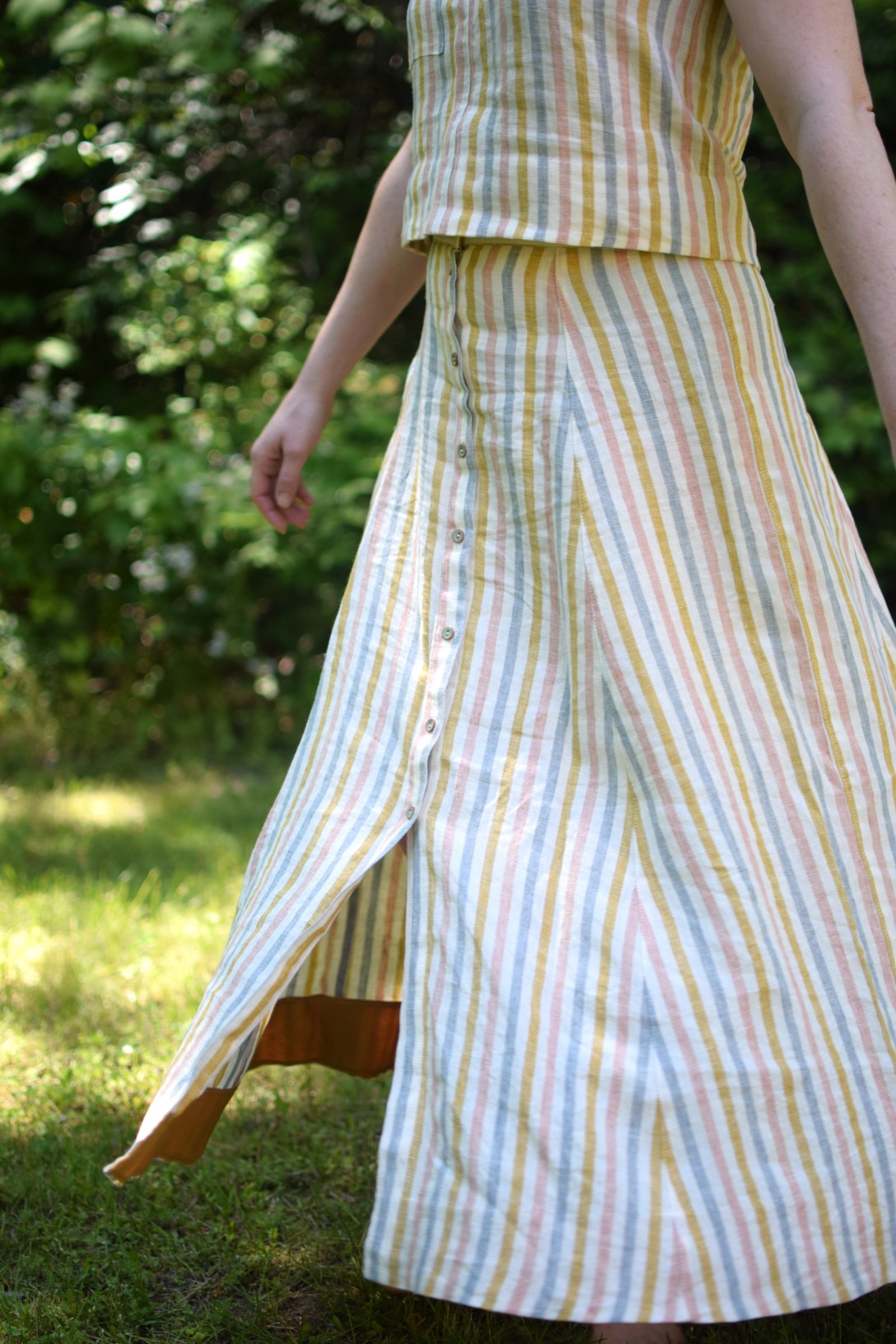
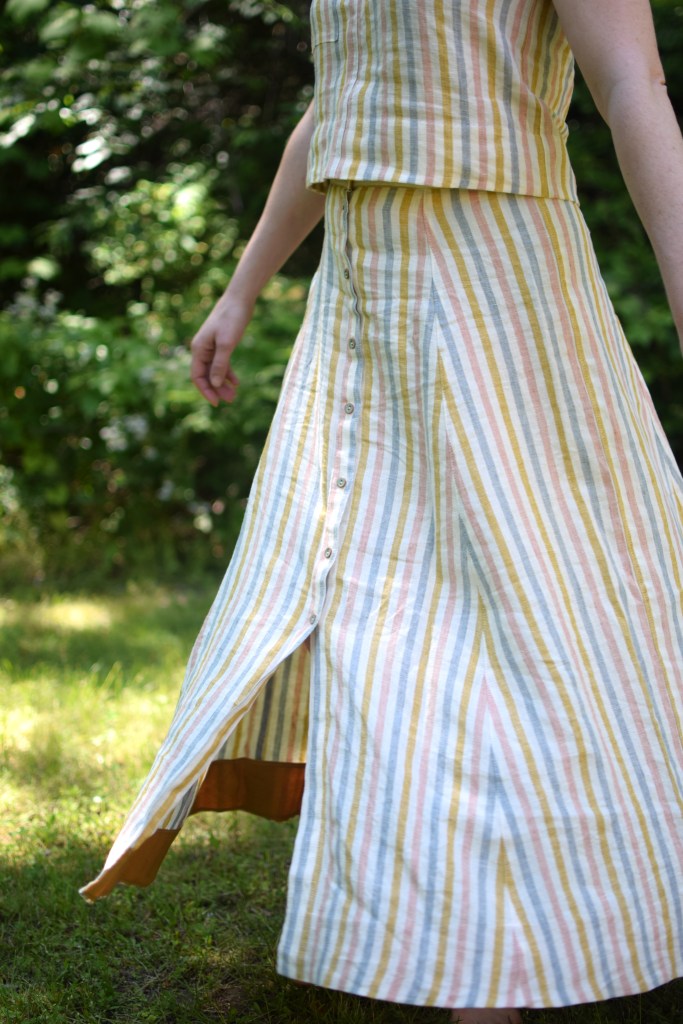
a woman twirls in a striped Wiksten tank top and Fumeterre skirt from Deer and Doe.

We escaped upstate for a long weekend. And, me being me, I made sure we had a few moments to squeeze in a photoshoot of this new skirt/top combo. After quarantining in the city for 3 months, it was amazing to be somewhere else. We went on 2 fire tower hikes and spotted some small snakes (eep!). Upstate New York is glorious in June.

The Skirt

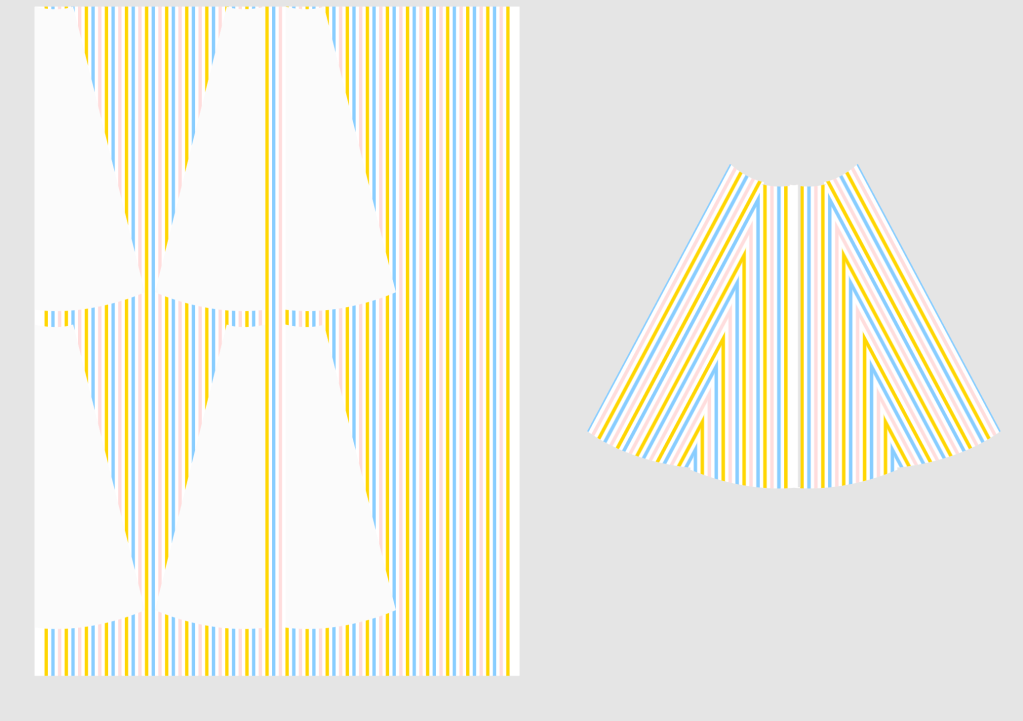
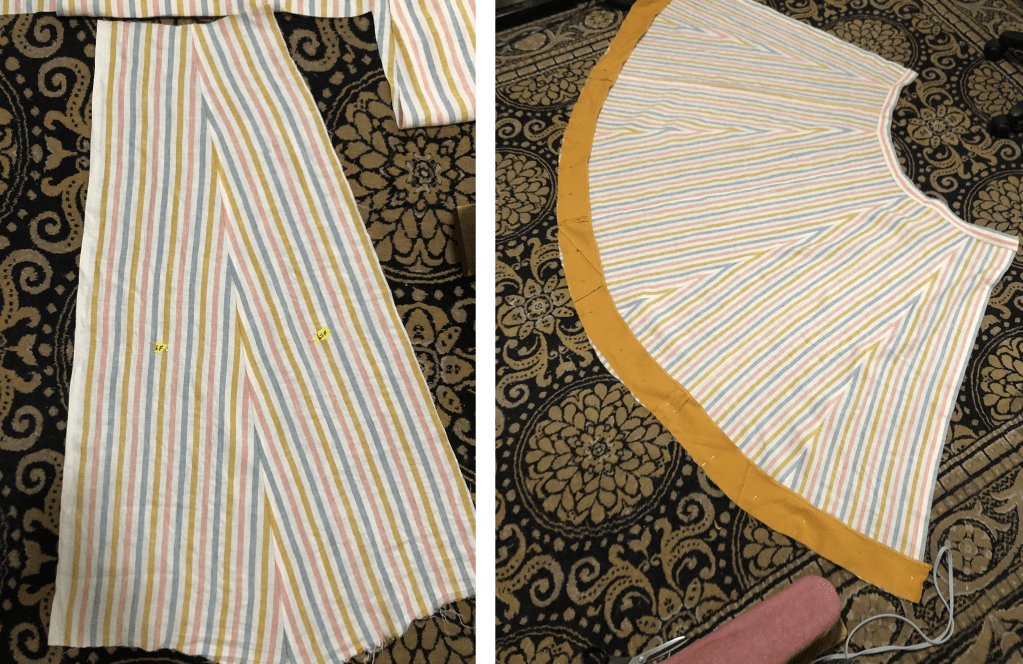
Anyway, here’s the story of these garments. I had some Merchant and Mills linen in my stash since last summer. I wanted to make something special with it, and earmarked it for a dress. Then, I thought of making a summery Fumeterre skirt instead. I hesitated because the thought of matching those stripes seemed overwheliming. After deliberating, I decided to give it a try. I re-created the fabric pattern in Figma, since this fabric has one-way stripes. I decided to focus on matching the angled mitres. I labeled 8 pieces of washi tape with each panel name (left front, left side front, right front, right side front, etc). I worked in groups of two so I could ensure the stripes matched at each mitre. I cut out 1 piece, then took its matching pattern piece, flipped it over, and matched the already cut stripes to it. I stuck the labels on each panel and sewed the angled seam. This labeling and batching system helped me keep everything straight.

a vector mockup of the fabric.
^ this is not how i ended up cutting out the skirt
progress photos of making a Fumeterre skirt from Deer and Doe
You can barely tell that I didn’t worry about making the straight stripes perfect. It looks like a 5-panel skirt!

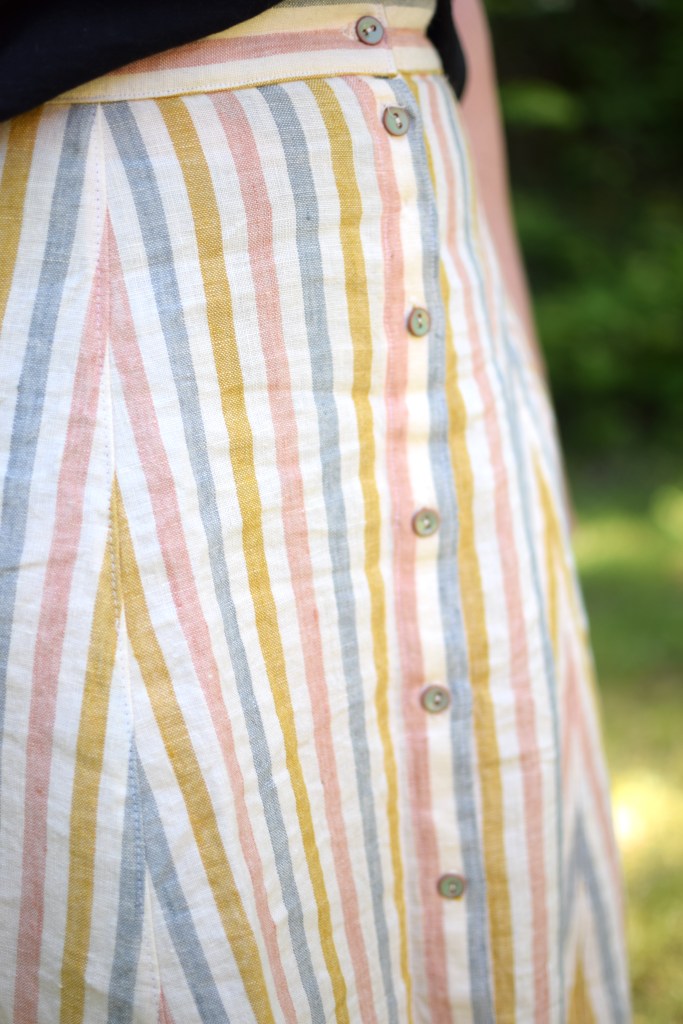
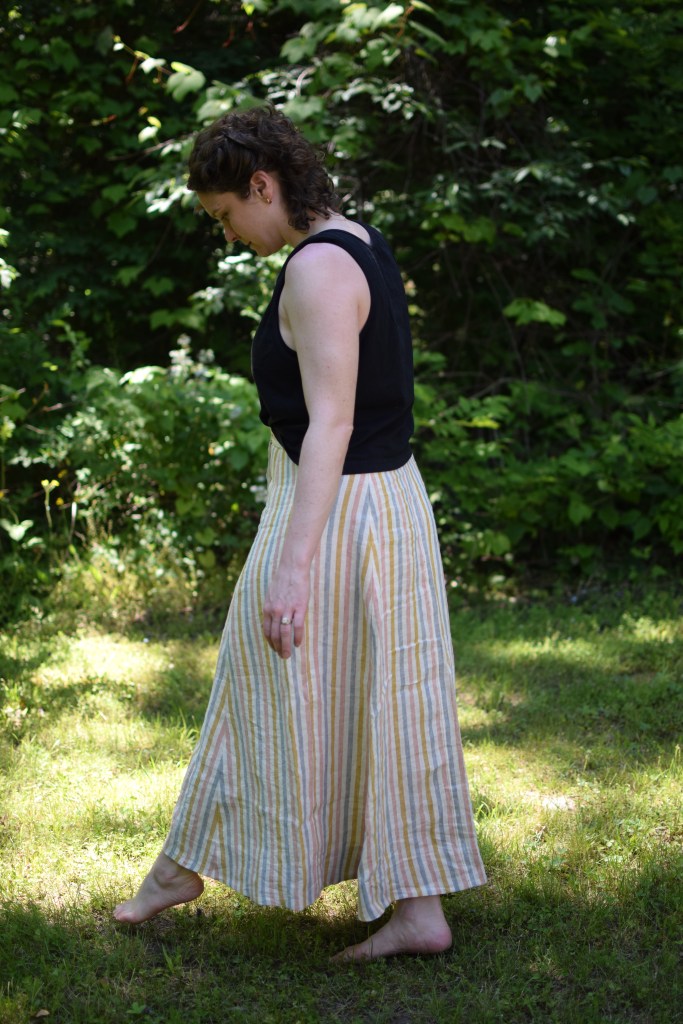
The skirt buttons are from Haulin’ Hoof Farm Store. I bought them at Vogue Knitting Live this year (crazy to think about going to an event like that with SO MANY PEOPLE). I was dumb and skipped the interfacing for the placket, and you can tell. I added an “inside button” between the first and second buttons below the waistband to help with gaping. I shortened the skirt by several inches because the length of my first Fumeterre makes it very hard to walk. I am very fond of the midi skirt length.

a striped Fumeterre skirt from Deer and Doe with pretty blue buttons.

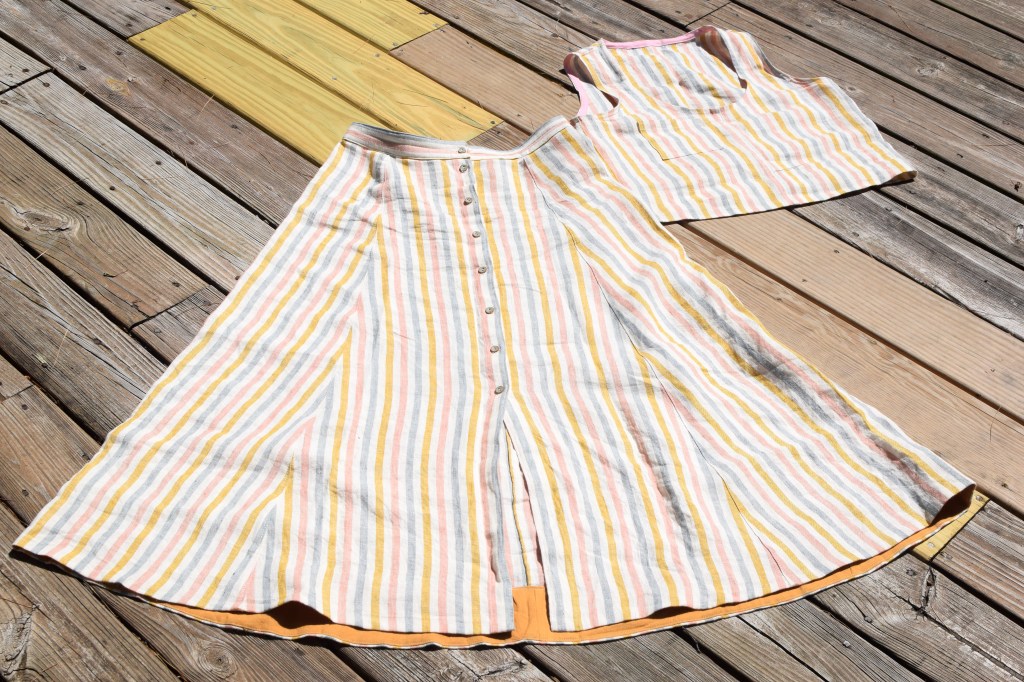
For the waistband and skirt hem facing, I used some leftover Spectrum Cotton from Purl Soho. I had so little fabric that I pieced the facing, but I can’t tell. I love how the facing and the waistband lining contrast with the linen stripes. The spectrum cotton is pricey but its so nice and soft. I will definitely use it again.

A Wiksten tank top and Fumeterre skirt from Deer and Doe laid on a deck.
a woman stands outside wearing a long striped Fumeterre skirt from Deer and Doe.

The Tank

I had very few scraps after cutting the skirt. But, I did have enough to eek this modified Wiksten tank out of the leftovers. I had so little left that I had to cut 2 pieces for the bodice front.

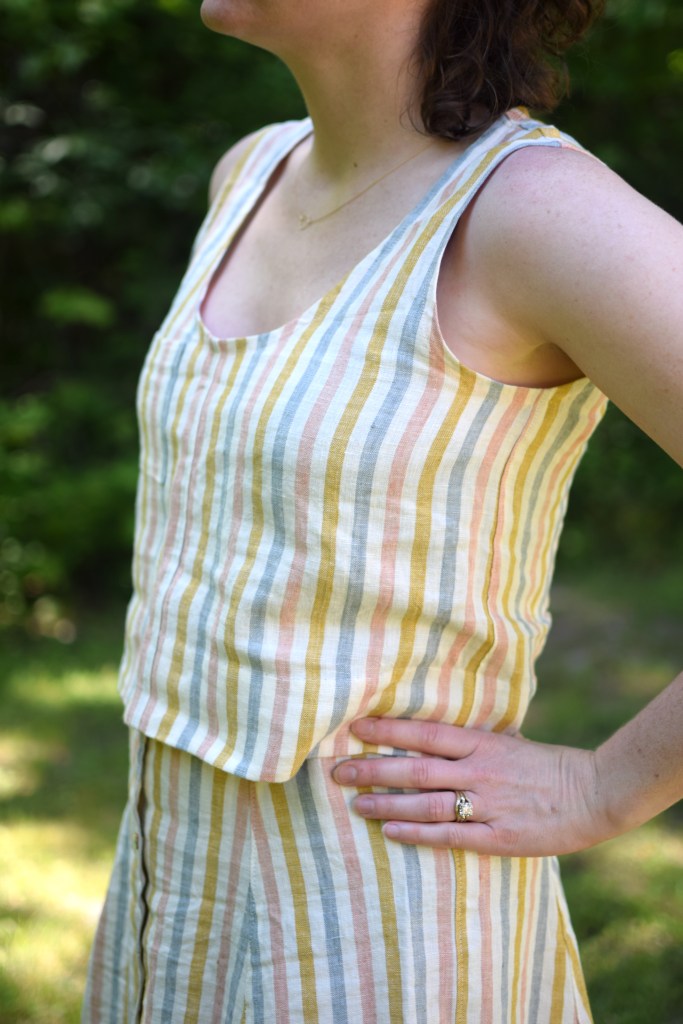
I cropped the tank by several inches and removed almost all the A-line shaping and hem curve. I also added a hand-stitched deep hem facing. There’s something about the armholes/strap drafting of this tank that I don’t love. The back gapes at the neck and the arms don’t lay nicely. The linen stripes are carrying this top, for sure. Overall, though, its a great summer top!

a woman stands outside, wearing a striped Wiksten tank.